
'No More War'
There's a massive gulf between what Americans say they want and what their leaders are doing.

During a speech Saturday night, Sen. Bernie Sanders (I-Vt.) notified a crowd in Tulsa, Oklahoma that President Donald Trump had just bombed Iran. Attendees immediately broke out into a “No more war!” chant.
It was meant as an imperative – a command to our government – but it may as well have been a cry of anguish. There will be more war.
The most important dynamic to me right now is the gulf between what Americans say they want and what their leaders are doing.
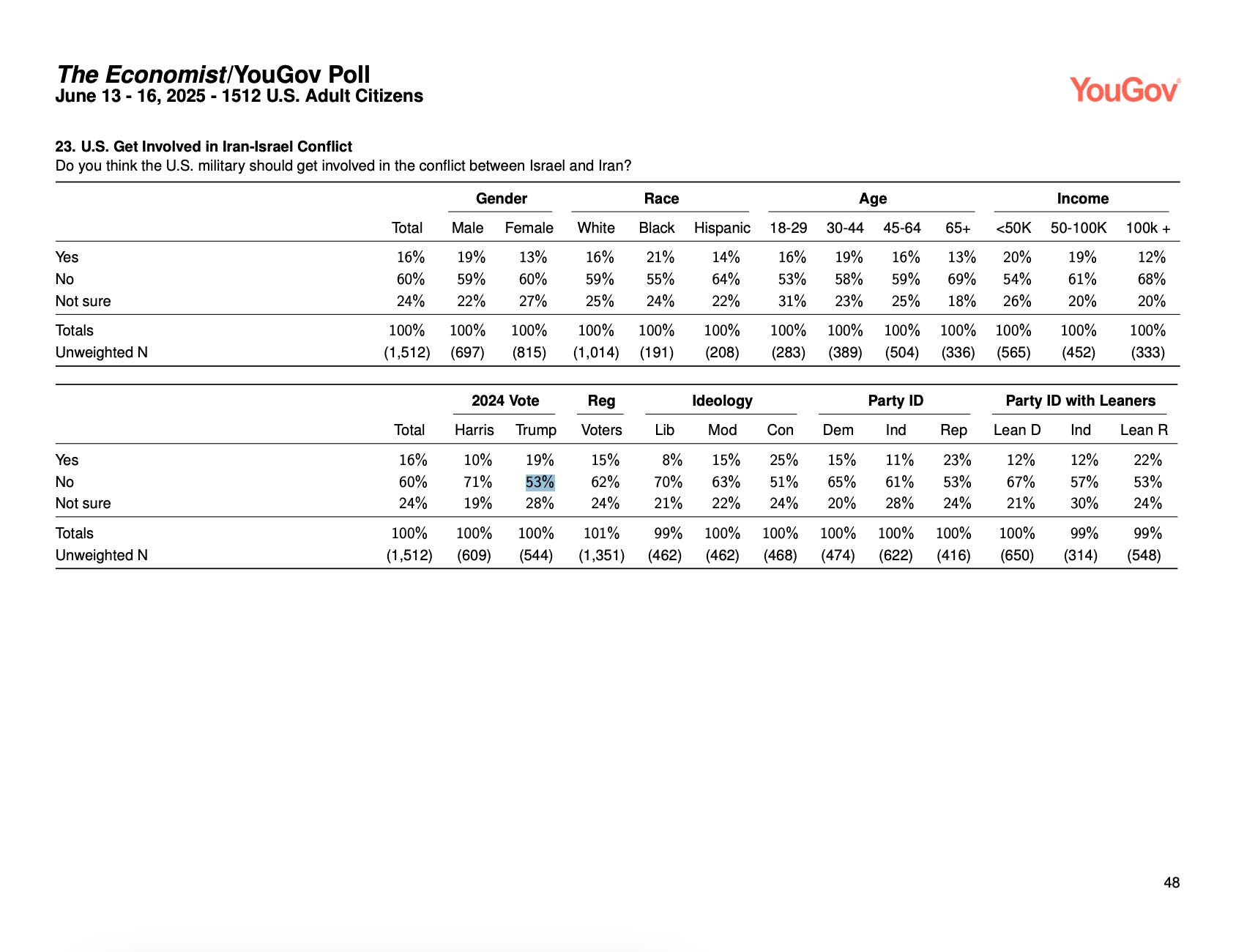
War with Iran is monumentally unpopular. Take a look at this polling from The Economist/YouGov, from a few days ago. The question is, “Do you think the U.S. military should get involved in the conflict between Israel and Iran?” Outright majorities of every group, including Trump supporters, said “no.”
On the other hand, America’s political leadership seems either fully on-board with, or half-heartedly resigned to, Trump’s acceleration of a world war.
Trump made the “right call,” and it’s okay that he didn’t receive legally-required congressional approval, House Speaker Mike Johnson (R-La.) said. Senate Majority Leader John Thune (R-S.D.) stands “with President Trump.”
Senate Minority Leader Chuck Schumer (D-N.Y.), who notably opposed former President Barack Obama’s nuclear deal with Iran, actually egged Trump on a couple weeks ago, accusing him of “TACOing” (Trump Always Chickens Out) when it came to negotiating with “the terrorist government of Iran.” Schumer accused Trump of pursuing a “side deal” that “lets Iran get away with everything.” (Even referring to “negotiations” seems facetious, given the timing of the past few weeks.)
After the strikes, Schumer demanded a vote on Trump’s war powers, but actually spent much of his paragraph-long statement criticizing Iran, urging Trump to “provide answers,” and lamenting the fact that “No president should be allowed to unilaterally march this nation into something as consequential as a war with erratic threats and no strategy” – a grammatical construction that reduces the top-ranking Democrat in government to a powerless observer.
For his part, House Minority Leader Hakeem Jeffries (D-N.Y.) scolded Trump for "fail[ing] to seek congressional authorization” for the strikes Saturday, but he also didn’t actually insist that Trump do so moving forward. He said Trump’s actions “risk American entanglement,” as if we aren’t already entangled. We were entangled before the strikes, too, by providing funding, weapons, and diplomatic cover for Israel’s attacks on Gaza, the West Bank, Lebanon, Syria and Yemen. Another word for that is “world war,” but you wouldn’t know that from Trump’s opposition party.
This is my point. President Joe Biden did nothing to restrain Israel’s attacks on any of those countries. He even joined in on attacking Yemen. (No, Congress didn’t sign off on that, either.) The official death toll in Gaza today has reached nearly 56,000, according to Palestinian officials – almost certainly a severe undercount. But it was already at 47,000 when Biden left office, after more than a year of Democratic leadership systematically sidelining any criticism of Israel’s actions, or of the Biden-Harris administration’s support for them. Their marginalization of those critics likely cost Harris votes, for what it’s worth. Now, with American bombs falling over Tehran (and American planes dropping them) the lack of a political alternative to militarism is even more stark.
What’s more, Trump now likely feels free to act with impunity, and without congressional authorization, because leaders of both major parties have been allowing presidents of both major parties to do the same for decades. Israel’s destruction of Gaza has received bipartisan support, regardless of whatever equivocating statements leaders of both parties dribble out about it. Why would Trump expect any different with regard to Iran?
Trump – and Tucker Carlson, and others – actually capitalized on Democrats’ political failures, profiting from vague, misleading gestures at non-interventionism because Democrats let him get away with it by refusing to offer an argument to his left. Neither Biden nor Harris ran on an anti-war message. Harris, who as a candidate focused on “transnational gangs” rather than articulating the benefits of immigration, similarly spoke on the campaign trail about “ensuring America always has the strongest, most lethal fighting force in the world.” She could have instead used those three simple words – “No more war” – but she didn’t.
Thankfully, it’s not my job to offer political strategy or opinion. But I can look at the past. I grew up during another world war, the “Global War on Terror.” I remember watching George W. Bush’s support slip away as the day-to-day failures of our wars in Iraq and Afghanistan became undeniable. Then as now, Democrats failed to offer a meaningful alternative to endless war. Eventually, Barack Obama took up that mantle, at least rhetorically. Just like Trump, it didn’t take much for Obama to pitch himself as nominally anti-war, and just like Trump, his campaign rhetoric bore little resemblance to his tenure as president. It’s like they say: You campaign in poetry, you govern with drones.
Will Democrats offer an anti-war message? Probably not. Rather, the fact that Trump now holds the levers of power will be enough. Militarism itself is not the problem, the argument will go, Trump’s mismanagement is. But by now, voters seem frustrated with this evasion. So the heat turns up, and steam builds in the American pressure cooker.